Microsoft: The Cloud Empire Tested by AI Monetization
- Administrateur
- Apr 24
- 3 min read
A global platform at the heart of digital transformation
Microsoft Corporation (MSFT) remains one of the undisputed pillars of the global digital economy, with a market capitalization hovering around $3.5 trillion, placing it among the most highly valued companies on the planet. Led by Satya Nadella, the group organizes its activities around three strategic segments: Productivity and Business Processes (Microsoft 365, Teams, LinkedIn, Dynamics), Intelligent Cloud (Azure, servers, enterprise services), and More Personal Computing (Windows, Xbox, Surface, Bing advertising).
Strategic levers: AI as the new valuation foundation
Microsoft's positioning rests on a particularly robust competitive triptych. First, the alliance with OpenAI – materialized by a cumulative investment exceeding $13 billion – has given the group a significant technological lead in the generative AI race, though this relationship is becoming more complex following OpenAI's recent openness to other cloud providers (Oracle, SoftBank via Stargate). Second, Copilot's vertical integration spans the entire Microsoft 365 suite, GitHub, and Dynamics, creating massive lock-in on its installed base of over 400 million paying seats. Third, Azure is establishing itself as the infrastructure of choice for enterprise AI workloads, benefiting from a unique hybrid ecosystem compared to AWS.
Competition is nonetheless intensifying. Amazon Web Services maintains cloud market share leadership (approximately 31% vs. 25% for Azure per Synergy Research), while Google Cloud is rapidly gaining ground on AI workloads thanks to its proprietary TPUs and Gemini's success. Microsoft must also contend with the emergence of high-performing open-source models (Meta's Llama, Mistral, DeepSeek) that are reshaping the economics of inference.
Recent news: record investments and regulatory pressure
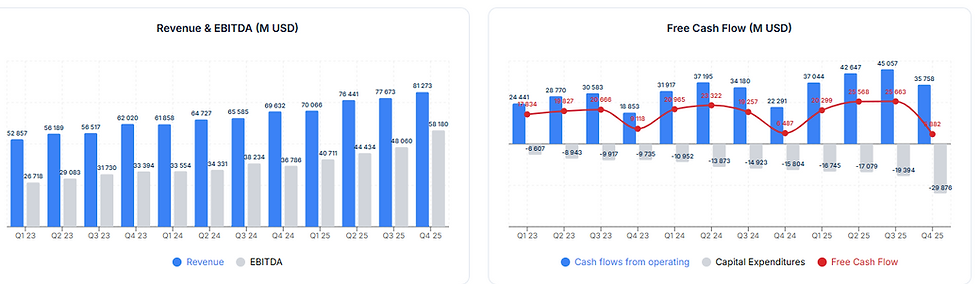
The group announced a historic CapEx plan of $80 billion for fiscal year 2025, largely dedicated to AI data centers. This capital intensity – unprecedented in software history – raises market concerns about medium-term return on investment and mechanically compresses Intelligent Cloud operating margins.
On the regulatory front, the FTC has opened an in-depth investigation into Microsoft's anti-competitive practices in cloud and software licensing. In parallel, the European Union is scrutinizing Teams integration and the OpenAI relationship. The Activision Blizzard acquisition ($69 billion), finalized late 2023, is beginning to generate gaming synergies with successful Game Pass integration.
On the partnership side, the agreement with Constellation Energy to reopen the Three Mile Island nuclear plant illustrates the energy shift imposed by AI and the resulting ESG constraints.
Specific focus: real Copilot monetization
The market awaits tangible evidence of generative AI monetization. Copilot for Microsoft 365, priced at $30 per user per month, shows encouraging but heterogeneous adoption rates across verticals. Enterprise deployments reveal sometimes disappointing ROI in early cohorts, prompting Microsoft to accelerate the integration of autonomous agents (Copilot Studio, Copilot Agents announced in November 2024) to justify the price premium.
The challenge for coming quarters will be the conversion of AI infrastructure growth into recurring application revenue. To date, approximately 12 percentage points of Azure growth come from AI workloads, a level that must be sustained to validate the high multiples.
Investment outlook
Microsoft presents a rare profile: double-digit growth, operating margins above 45%, free cash flow generation exceeding $70 billion annually, and a positive net cash balance sheet. Key risks lie in infrastructure cost inflation, increasing regulatory pressure, and potential normalization of large enterprise AI investments. Visibility remains supported, however, by an exceptional commercial backlog (RPO exceeding $259 billion), which provides a valuable buffer against investment cycles.

Comments