Alibaba Group: A Chinese Giant's Strategic Awakening Amid AI and Trade War Pressures
- Administrateur
- Apr 30
- 2 min read
A sprawling business under reorganization
Founded in 1999 by Jack Ma, Alibaba Group Holding (NYSE: BABA; HKEX: 9988) remains a pillar of China's new economy. Since the March 2023 restructuring, the group operates through six segments: domestic e-commerce (Taobao and Tmall Group), international (AliExpress, Lazada, Trendyol), cloud computing (Alibaba Cloud), logistics (Cainiao), local services (Ele, Amap), and media and entertainment (Youku, Alibaba Pictures).
The architecture, originally designed to unlock value via separate IPOs, has been partly
reversed, with the group ultimately keeping Cloud Intelligence as its AI strategy spearhead.
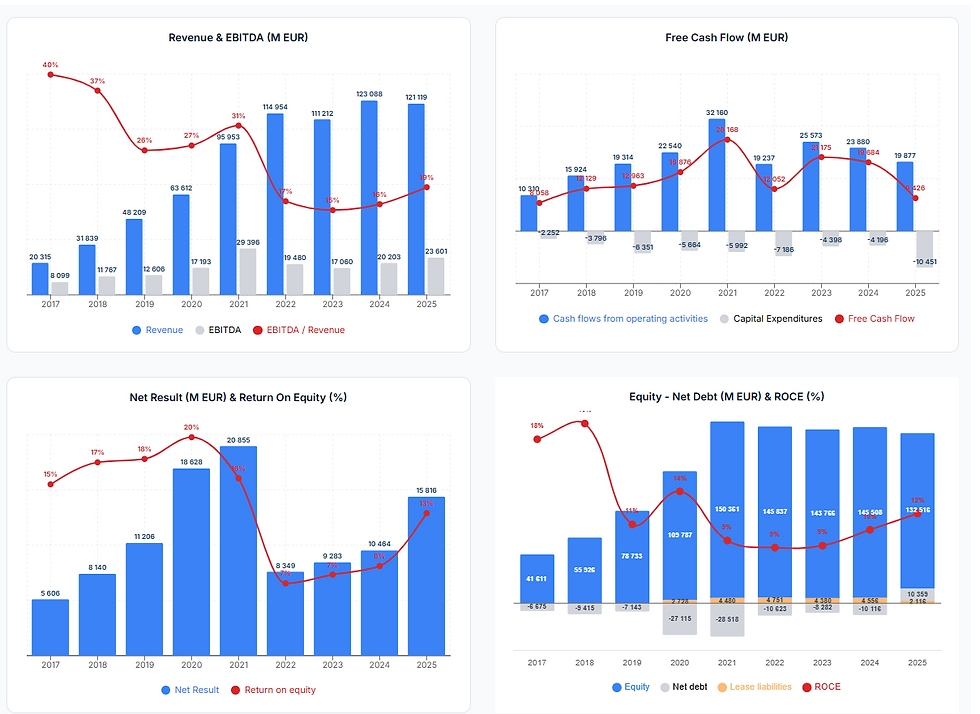
With revenue of RMB 996.3 billion for the fiscal year ended March 2024 and net cash exceeding RMB 400 billion, Alibaba retains substantial firepower despite slowing growth and a persistent valuation discount versus US peers.

Strategic levers: refocusing, AI and reconquest
Alibaba's positioning is being reshaped by a transformed competitive landscape. In domestic e-commerce, Taobao and Tmall face fierce competition from PDD Holdings (Pinduoduo) in discount retail and ByteDance (Douyin) in video commerce. Market share losses—from over 65% five years ago to around 40% today—have forced the group to reinvest heavily in user experience, pricing, and merchant support, compressing core segment margins.
Internationally, AliExpress and its new Choice offering are gaining traction in Europe and the Middle East, while Lazada is showing operational recovery in Southeast Asia, reaching positive EBITDA in 2024. Cainiao, whose IPO was cancelled, has become a strategic asset for cross-border logistics.
But it is cloud and AI that now anchor the investment narrative. Alibaba Cloud, China's leader with about 36% IaaS market share per Canalys, is benefiting from explosive demand tied to generative AI. The open-source Qwen model family is emerging as a global reference, fueling renewed commercial momentum and double-digit cloud growth.
Recent news: investment turning point and renewed confidence
In February 2025, Alibaba announced a historic investment plan of over RMB 380 billion (USD 52 billion) over three years in cloud and AI infrastructure—exceeding the past decade's total spend. The announcement triggered a spectacular rally, supported by the symbolic meeting between Jack Ma and Xi Jinping, viewed as the formal end of the regulatory disgrace weighing on the group since 2020.
The partnership with Apple to integrate AI features into iPhones sold in China is a major industrial validation. Alibaba has also accelerated buybacks, executing over USD 12 billion in 2024, supporting EPS.
On the macro front, US-China tariff tensions revived by the Trump administration represent a dual risk: on AliExpress cross-border flows (end of de minimis exemption in the US) and on New York-listed ADRs, whose status remains under threat.
Specific points: valuation and investment thesis
With a forward P/E of around 12x and EV/EBITDA near 8x, Alibaba trades at a substantial discount to Amazon (35x) or Microsoft (30x), partly justified by the China geopolitical risk premium. AI optionality, now recognized by the market, supports a gradual re-rating. Sum-of-the-parts valuations alone place Cloud Intelligence at USD 100–150 billion, a growing share of total market cap (around USD 280 billion).
The main catalyst remains the inflection of domestic e-commerce margins, expected as Taobao monetization improves through take-rate and advertising. Conversely, downside risk stems from intensifying price wars with PDD and tightening US regulation.
Alibaba thus presents itself as a turnaround case with strong operating leverage, hinging on AI execution and the normalization of Beijing-Washington relations.

Comments